National Rehabilitation Awareness Week: Rebuilding Daily Routines When Dementia Complicates Recovery at Rochester Center (Rehabilitation and Dementia Rochester NY)
Seventy-five feet. On a rehabilitation chart, it looks like a modest walking goal. Then the resident grips both chair arms and asks again who left that walker there. The numbers have company.
Muscle may be getting stronger even as the order of a transfer keeps slipping away. Tuesday’s lesson comes back on Wednesday as a vaguely familiar puzzle. Noise from the next set of parallel bars does not help. Neither does a therapist whom the resident has met three mornings in a row and still experiences as a stranger.
National Rehabilitation Awareness Week puts some welcome attention on physical recovery. Add dementia and the discussion gets less tidy. Standing, swallowing, dressing and getting safely to the bathroom remain the work. Memory loss changes how the work gets introduced, repeated and carried back into the resident’s day.
Rehabilitation and Dementia Rochester NY: Routine Becomes Clinical Information
The chart records 55 feet before breakfast and 12 after lunch. Read quickly, those figures resemble improvement followed by collapse. Read in context, they may describe the resident’s ordinary Tuesday.
Start with small irritants. A hearing aid stayed on the nightstand. The hallway television is louder. Breakfast barely got touched, or a new medication left the resident foggy. Dementia makes it harder to explain any of this on demand. Sudden confusion still gets escalated; infection, delirium and other medical changes do not get a free pass as “just memory.”
Structured screening supplies a few coordinates. BIMS, the short cognitive interview found in the current MDS 3.0 assessment, begins with three spoken words. The resident is asked for them again later. Questions about the year, month and weekday sit between those two moments. Useful? Yes. A portrait of the whole afternoon? Hardly.
Nursing notes, therapy observations and the family’s account give the score a life around it. Perhaps Dad has always faded at 1:00. Perhaps yesterday’s hesitation was new. Within several days, a workable rhythm often emerges: heavier walking practice during the bright morning window, dressing while clothes are naturally in hand, a quieter task later. Keeping bathing and meals near accustomed hours follows federal dementia-care advice as well. Routine can carry part of an instruction before anybody says a word.
Cueing, Repetition and the Tasks a Person Already Knows
“Feet back.” Wait. “Lean forward.” Another pause. “Push from the chair.”
That sounds almost comically spare until one compares it with the usual mouthful: stand, turn, grab the walker and head toward the cone. Working memory may drop the opening words before the direction has even ended. Short cues leave less to carry. A demonstration, colored marker or carefully placed hand can provide the missing piece when words are getting nowhere.
Wording counts too. If one therapist says “nose over toes,” another says “bend forward” and an aide says “get your weight up,” three people may believe they offered the same help. The resident heard three separate riddles. Reusing a cue gives it a chance to become recognizable.
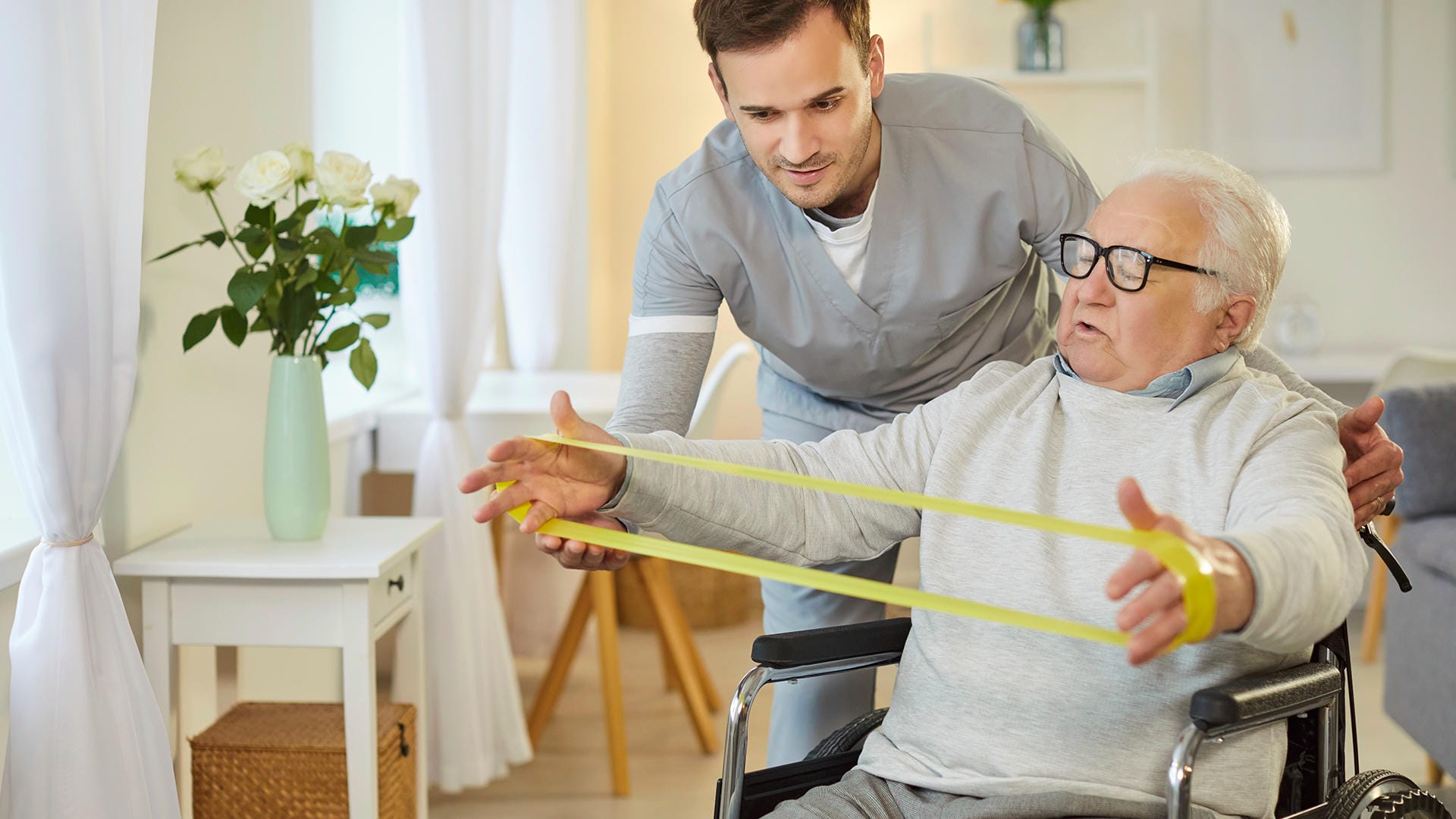
Then comes repetition, plenty of it. A bed-to-chair move is practiced in its ordinary order. Later, the chair shifts several inches or the therapist steps farther back. Can the resident begin the motion? Does one spoken prompt do the job, or are four still needed? The number of cues is a functional measure in its own right.
Familiar work can sneak in useful movement. Folding washcloths brings both hands across midline. Placing shirts on hangers asks for reach and balance. Grooming and toileting supply their own sequences, already tied to a lifetime of habit. Help comes in late enough to allow an attempt and early enough to head off a string of failures. Some days that interval is three seconds. Some days it is fifteen.
Pain and Fatigue in Rehabilitation and Dementia Rochester NY Care
Pain does not disappear when a person has trouble naming it. It may show up as guarding one hip, grimacing during a transfer, resisting care, calling out, eating less or suddenly refusing an exercise completed the day before.
When self-report is limited, clinicians may use an observational framework such as PAINAD. It organizes what staff see into five areas: breathing, negative vocalization, facial expression, body language and consolability. The score does not diagnose the source. It flags a pattern for nursing and the wider clinical team to investigate, document and reassess. Federal guidance for families makes the same practical point: a person with dementia may communicate discomfort through the face or behavior rather than a clear sentence.
Fatigue needs the same respect. Two shorter bouts separated by rest may produce cleaner movement than one long session after concentration has fallen apart. Therapists can track distance, assistance level, number of sit-to-stands and the quality of a transfer, then compare performance at similar times of day. “Had a bad afternoon” tells very little. “Needed moderate assistance after 40 feet, following poor sleep and lunch” gives the next shift something usable.
The Family Knows What the Chart Cannot
Ask which door Dad uses. The front entrance may look sensible on a floor plan, but he has gone through the kitchen door since 1989 and knows its two steps by feel. His daughter knows that. She also knows coffee comes before conversation and that he sleeps in a recliner, despite what the bedroom photo suggests.
Family details can rescue a therapy plan from abstraction. “Help is available” sounds reassuring until the team learns that the available person is a wife with arthritis who cannot steady a 180-pound husband. A walker may sail down the therapy corridor and still fail the turn into a narrow bathroom. Count the porch steps. Measure the doorway. Find out who is actually home at suppertime.
Caregivers can also tell staff whether a behavior is old, recent or startlingly out of character. They may recognize a phrase that gets cooperation when clinical wording draws a blank. During training, relatives need a chance to try the transfer themselves, use the chosen cues and ask the awkward questions. The plan can then move toward independent return, supervised mobility, hands-on assistance or continued support without springing the decision on everyone at the last conference.
Care. Support. Positive Outcomes. Rochester Center.
Beahan Road sees a broad slice of recovery. At Rochester Center, one resident may move from Stroke Care into Short-Term Rehab while dementia complicates the instructions. Cardiac Care can arrive with Pain Management. Wound Care may continue underneath a mobility plan. Dementia Care and Long-Term Care give the team room to address needs that will still be present after a short recovery window closes.
Those combinations rarely progress in a straight line. A resident headed home may be working on the side-door steps. Someone staying longer may focus on a safer transfer, steadier eating or enough endurance to take part in the afternoon. Nursing observations, rehabilitation notes and caregiver knowledge belong in the same conversation.
Ten more feet counts. So does reaching for the chair correctly after one cue, when last Monday it took four.
Steps to Home
Discharge planning begins with the life a resident is returning to: the side entrance, the usual chair, the bathroom turn, the person available to help and the hour when fatigue tends to arrive. Rochester Center’s team can rehearse those tasks, teach caregivers the cueing sequence and revise the plan as function changes. Our Steps to Home series follows patients through rehabilitation and the journey from hospital to home.
Our Steps to Home series follows patients through rehabilitation and the journey from hospital to home: