Planning Short-Term Rehab Around Shemini Atzeret and Simchat Torah 2026 at Boro Park Center
Hoshana Rabbah fell out on a Friday this year. Nobody in Boro Park needed reminding. You’re running around for the last challos, candles go up a little after six, and then it’s Shemini Atzeret on Shabbos and Simchas Torah on Sunday, back to back, no Chol Hamoed cushion, nothing until Monday.
Now put Mom in that picture. Eleven days post-op from a total knee, third floor, and she still wants to hear Kohelet. (No Shabbos Chol Hamoed this year, so in chutz la’aretz it gets read on Shemini Atzeret.)
Families arranging short-term rehab in Boro Park, Brooklyn for this stretch usually find the holes in the plan around Shabbos afternoon. Tuesday would’ve been nicer.
Who’s Doing PT on Shemini Atzeret? Short-Term Rehab in Boro Park, Brooklyn
Depends who you ask. Literally.
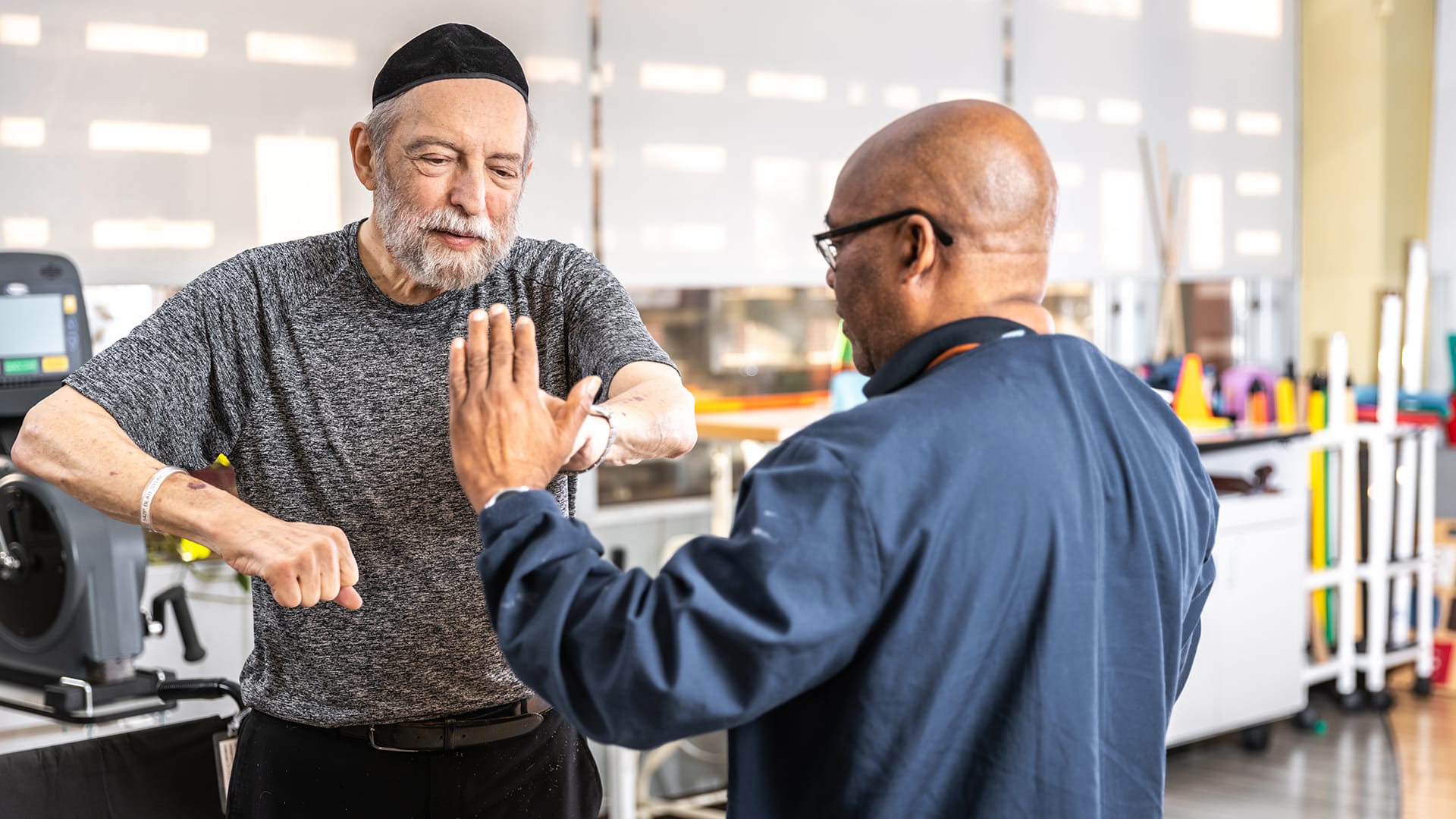
The rehab gym runs seven days, Shabbos included, because a stroke patient’s weak arm doesn’t take off for Yom Tov. Still, one resident will want to hold off on exercise until she’s spoken to her rav about refuah on Yom Tov (good luck getting a short answer, there are whole kuntreisim on it). Her roommate isn’t frum and wants her 10 o’clock slot right where it’s been. A third gentleman would like to double up on Thursday and then sit two days with a sefer.
Any of those can work. What can’t work is the therapist finding out at 9:55 Saturday morning.
So call. Get the times written down someplace. If Ta is planning to walk to his shtiebel, figure out how far it is, count the curbs too, and tell the PT this week. Eight blocks behind a rolling walker is something you rehearse in the hallway on Wednesday. Nobody wants the trial run happening on 13th Avenue.
Pain, Pills and a Very Long Davening
Here’s what goes sideways. Standing meds show up on time no matter what. The as-needed doses, the ones a patient has to ask for, quietly stop happening.
Bubby doesn’t want to make a tumult. She doesn’t want to ring for the nurse on Shabbos. So she sits there at a seven out of ten and tells everyone she’s fine.
Fix it ahead of time. Nurses can round on a set schedule, every few hours, and just ask, so nobody has to press anything. Oral pain medication takes maybe 30 to 60 minutes to do much; if Sunday’s session is at 10:30, the pill goes in around 9:45. Ice packs. A wedge pillow. Leg up after hakafos.
Boring stuff. It gets forgotten the minute somebody makes a l’chaim down the hall.
Herring Is a Sodium Delivery System
Three seudos. Kiddush after davening. A grandson walks in with his mother’s cholent and half a kokosh cake.
For a cardiac patient the problem is salt, and a Yom Tov table is more or less a salt museum. Herring, pickles, deli, chrain on everything. Heart failure patients usually get weighed daily, and a gain of 2 or 3 pounds in a day, or around 5 in a week, gets the doctor’s attention. Guess which day that shows up. Monday.
Stroke recovery is a headache from the other direction. Swallowing. Plenty of patients after a stroke are on altered textures, minced or pureed, thickened liquids, and an aunt holding a slice of potato kugel has no clue. Run outside food past the nurse, every time, even if it’s “just a bissel.”
Then there’s the sukkah. Some families eat in it on Shemini Atzeret, lots of chassidim don’t. Ask her what she does.
Yizkor Lands Different in a Rehab Bed
Yizkor gets said on Shemini Atzeret. If she lost her husband this past year, it’s her first one, and she’s in a room with a call bell and a roommate instead of the ezras nashim where she sat for forty years. Some people want company for that. Others want the door pulled mostly shut and nobody saying a word. Recreation and social work staff can do either; somebody just has to tell them which.
Twenty-four hours later, Simchas Torah. Loud, and for hours.
Standing up fast after a heavy meal and two nights of lousy sleep is how older adults get lightheaded. Orthostatic hypotension, it’s called, and it’s a big contributor to falls. Get him a chair at the edge of the circle. Or he watches from the wheelchair and someone carries the Torah over for him to hold for a minute, and people remember that minute for years, honestly.
Also sleep. Whatever happens Sunday night, Monday’s PT session is going to know about it.
Visitors, Flags and Short-Term Rehab in Boro Park, Brooklyn on Simchas Torah
Simchas Torah afternoon the streets are a mess (the good kind), kids with flags and pekelach, everybody on foot. So the whole family walks over. All of them. At once.
Twenty minutes of that is a mechaya. Forty and the patient is wiped. Stagger it, some on Shabbos afternoon, the rest Sunday. And before Yom Tov somebody should learn the name of the nurse in charge on the floor, since nobody’s answering a phone from Friday night till Sunday after dark. If something looks off Shabbos afternoon, you want a person you can walk up to.
One more thing. Plenty of residents in the building aren’t Jewish, and plenty of Jewish ones keep things very differently than you do. The man across the hall may want the game on. He’s allowed.
Boro Park Center, 10th Avenue
Boro Park Center sits at 4915 10th Avenue, right where Boro Park’s Jewish neighborhood runs into the Asian community next door, and the staff have been through more than a few Tishreis. Short-term rehab goes through RehabStrong with physical, occupational and speech therapy; the center also handles pain management, cardiac care, stroke care and an Ultra-Care Unit for patients who need closer watching. Call early in the week. Talk times, menus, who’s coming when.
Care. Support. Positive Outcomes. Centers Health Care.
Centers Health Care provides rehabilitation, skilled nursing and long-term care for people with a wide range of needs. Whether someone is recovering from surgery, managing an illness or simply needs more support than can be provided at home, our staff is there to help.
The goal is not exactly the same for everyone. It may be returning home, becoming stronger, staying independent or simply feeling better and more comfortable from one day to the next. There will be progress, setbacks and difficult days along the way. Our job is to be there through all of it, and to help each patient or resident get as far as he or she can.
Sometimes that progress comes in large steps. More often, it comes in small ones. Either way, every step matters.
Our Steps to Home series follows patients through rehabilitation and the journey from hospital to home: