National Rehabilitation Awareness Week: Preparing for Finger Lakes Fall Outings After Orthopedic Rehab at Ontario Center | Orthopedic Rehabilitation Canandaigua NY
The first cold morning usually gives it away. Somebody starts talking about a drive around Canandaigua Lake, a farm stand, lunch outdoors or one last walk before the leaves come down. Then a fairly ordinary question interrupts the plan: can I get into the car without twisting the new joint?
National Rehabilitation Awareness Week runs September 14–20, 2026, under the theme “Building Futures Through Rehabilitation.” That future can sound grand in a national campaign. During a therapy session, it may look like a patient lifting one leg over a practice car threshold while keeping the precautions set by the surgical team. Both versions count.
Orthopedic Rehabilitation Canandaigua NY Starts at the Car Door
A hallway distance tells part of the story. The parking lot adds a curb, a door that swings back, a seat that feels lower than expected and a family member offering help from exactly the wrong angle.
Car-transfer practice can be broken down. The patient approaches with the prescribed device, turns without crossing or pivoting unsafely, controls the descent, moves back far enough on the seat and brings the legs inside. The sequence will vary with the operation and current precautions. So will the amount of assistance. Therapists can also look at the likely vehicle rather than practicing for an imaginary sedan when the family owns a high SUV.
Before an outing, try the transfer with the person who will actually drive. Leave enough room to open the door fully. A slick pile of leaves beside the passenger side deserves more attention than the view.
A Finger Lakes Walk Is More Than a Distance
“I walked 300 feet” sounds wonderfully precise until one asks what happened at foot 220. Did the step length shorten? Did pain climb? Was there dizziness after standing? How long did breathing take to settle?
Depending on the patient, a rehabilitation team may use a Timed Up and Go, a sit-to-stand test, a measured gait-speed trial or a longer endurance walk. These measures create useful comparison points. They do not automatically answer whether somebody is ready for a busy market, a lakeside path or a family afternoon with nowhere convenient to sit.
Practice the shape of the outing. Walk, stop at a bench, stand again and return. Add conversation, a doorway and a turn. If cardiac recovery, stroke effects or pain complicate orthopedic rehabilitation, pulse, blood pressure, symptoms and perceived exertion may need to be watched along with distance. “Fine” remains a rather unhelpful unit of measurement.
Taking Orthopedic Rehabilitation Canandaigua NY Onto Uneven Ground
Finger Lakes scenery has topography. Even a short destination can include gravel, damp grass, a sloped shoulder, roots, stone steps or leaves hiding the edge of the pavement. At Watkins Glen State Park, for example, the Gorge Trail passes 19 waterfalls in a one-mile stretch and typically stays open only into mid-October, depending on weather. Beautiful, yes. Also a poor place to discover that a walker catches on loose stone.
Therapy can rehearse surface changes in a controlled setting. Patients learn where to place a cane or walker, how to shorten a step on uncertain ground and how to turn around before fatigue wrecks their form. Families should check current trail conditions and ask the destination about accessible routes, restrooms, drop-off points and benches. New York State Parks specifically advises visitors to confirm conditions for some Finger Lakes trails before traveling.
The CDC’s current fall-prevention guidance treats falls as the product of several risks accumulating together. Weakness, an unfamiliar surface, poor footwear and a rushed turn can arrive in the same ten seconds. Fear deserves attention too. After a fall, some older adults cut back on activity; the resulting weakness can increase future risk. The answer is graded, supervised practice and a plan suited to that patient.
Carrying the Small Stuff Changes the Job
A phone, sweater, water bottle and medication pouch do not weigh very much. Put them in one hand while the other hand belongs on a cane and the arithmetic gets awkward.
Occupational therapy can test how a patient retrieves, packs and carries necessities without giving up the support required for safe walking. A small backpack, cross-body bag or walker basket may solve the problem. Maybe a companion carries everything. That is a perfectly respectable solution.
Leave the oversized picnic cooler to somebody else.
Spend Energy Like It Has to Last
Autumn gives one bad piece of advice: keep going. The air is cool, the view improves around the bend, and the car is meanwhile getting farther away.
Suppose a patient walks for ten useful minutes before the stride turns sloppy. Five minutes out may be the honest plan. Therapy can time how long breathing and leg control take to recover after a seated rest. A family member can map the benches, park near the entrance and keep a folding chair in the trunk. The patient’s prescribed device comes along even when everybody hopes it will stay folded.
A drive around the lake with one careful stop may be enough that day. Good. Save the ambitious route for another afternoon.
Care. Support. Positive Outcomes. Centers Health Care.
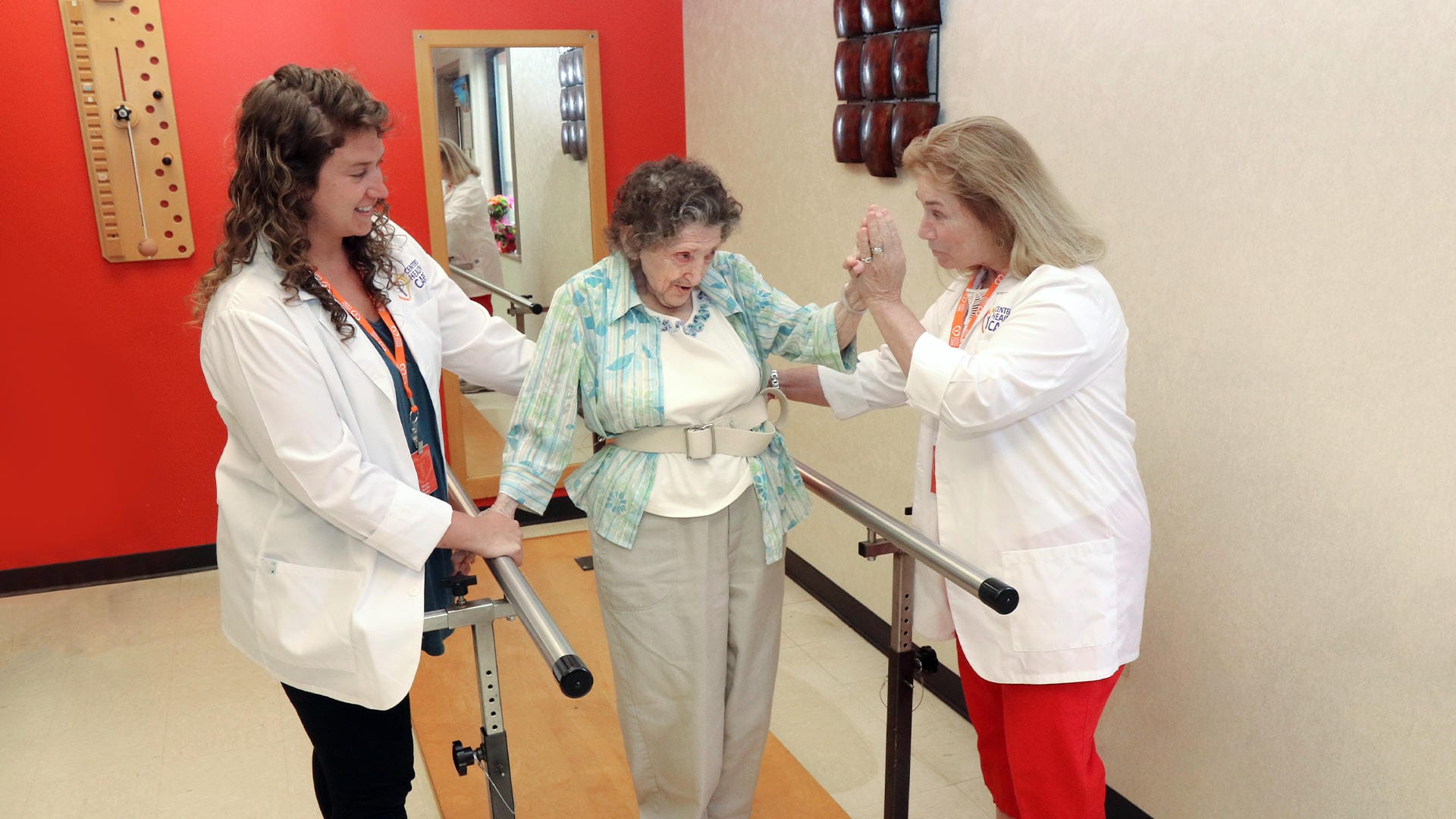
Ontario Center in Canandaigua provides orthopedic care, short-term rehabilitation, cardiac care, stroke care and pain management, along with dementia care, long-term care and wound care. Its rehabilitation program can connect therapy targets to the outing a patient hopes to take: entering the family car, walking farther without losing form, handling variable ground, carrying essentials and budgeting enough energy to return. Progress may come as another fifty feet, an easier transfer or the judgment to stop early.
Steps to Home
The Steps to Home approach keeps the eventual destination inside the rehabilitation plan from the beginning. Staff can practice the transfers and daily tasks a patient expects to face, review equipment and precautions, involve family in hands-on instruction and adjust goals when the clinical picture changes. Home might be the next stop. First, perhaps, a quiet look at the lake.
Our Steps to Home series follows patients through rehabilitation and the journey from hospital to home: